Although Pinterest Inc (NYSE:PINS) fundamentally operates as a visual discovery and search engine platform, many users increasingly consider it an artificial-intelligence-driven enterprise. Essentially, AI now underpins nearly every aspect of its operations, from core user experience to advertising tools. On the surface, that would seem to help bolster PINS stock given the intense fervor regarding the innovation. As it currently stands, investors have other ideas.
It really comes down to technical performance. Since the start of the year, PINS stock is down roughly 11%. Granted, the negativity hasn’t been a straight, linear shot of pessimism. During certain pockets of time, PINS appeared to be an emerging star. Unfortunately, the notion of an ascendant rally has been negated by the security’s trailing-six-month loss of over 27%.
Still, for options traders, Pinterest stock may present an intriguing comeback narrative, at least in the short term. First, the market rarely sees a security incur a straight downward trend. Instead, the equities arena is reflexive, meaning that, at a certain point, perceptions can often alter reality — especially if those perceptions are reinforced through feedback loops.
In other words, it’s quite possible that investors may view PINS stock — which is now trading at a much more attractive multiple relative to six months ago — as a discounted opportunity. Sure, the market has rejected Pinterest stock at $40. However, the same security at less than $30 could be enough to make skeptics reconsider.
Put simply, everybody in the market has a price. There are really no such things as permabulls or permabears. At some point, the price is right for a sentiment transition. It’s here that we can segue into the quantitative argument.
Using Risk Geometry To Find The Transition Zones
Much of the reason why Black Friday is such a powerful force in retail stems from the underlying psychological pull. Essentially, people are incentivized by a combination of scarcity, fear of missing out (FOMO) and the thrill of getting a good deal. Of course, studies have demonstrated that, many times, the deal isn’t fundamentally all that great.
Nevertheless, people still participate in Black Friday shopping because they believe they’re getting a great deal. To be sure, human feelings represent an unbounded emotion that cannot be directly quantified. But the nuance that gets lost in the discussion is that the collective impact of these emotions can be measured — and can be predicted with a reasonable magnitude of confidence.
My theory is that we can use these same principles to trade PINS stock options.
Let’s consider a single 10-week strand of discretized PINS stock price data. Obviously, the return during this period won’t tell us anything about the probability of performance for the other weeks in the dataset. But if we stacked hundreds of rolling 10-week trials in a fixed-time distribution, the most consistent, frequent pricing behaviors will create bulges in probability mass.

These bulges represent risk geometry, which in part shows the ascendance of bullish sentiment among buyers. More importantly, risk geometry reveals the transition zone where buyers are tempted to become sellers. Therefore, we know where to push — and where to back off.
Since Pinterest’s initial public offering, past data reveals that its median forward 10-week returns would likely range between $25.20 and $26.80 (assuming an anchor price of $25.95). However, we’re more interested in the statistical response to the current quantitative signal, which is the 4-6-D sequence. In the trailing 10 weeks, PINS stock has only printed four up weeks, leading to an overall downward slope.
Under this setup, the security would likely range between $25 and $28 over the next 10 weeks, with price clustering occurring at around $26.60. Still, the biggest takeaway is that the peak of probability mass would be greatest between $26.25 and $27.
Two Intriguing Trades To Consider
A key advantage of calculating risk geometry — which is not a standard metric and thus gives you a clear edge in the market — is that we can visualize the likely acceleration of probability decay. Between $26.50 and $27, probability density declines by 24.95% on a relative basis. However, between $27 and $27.50, density plunges by 76.42%.
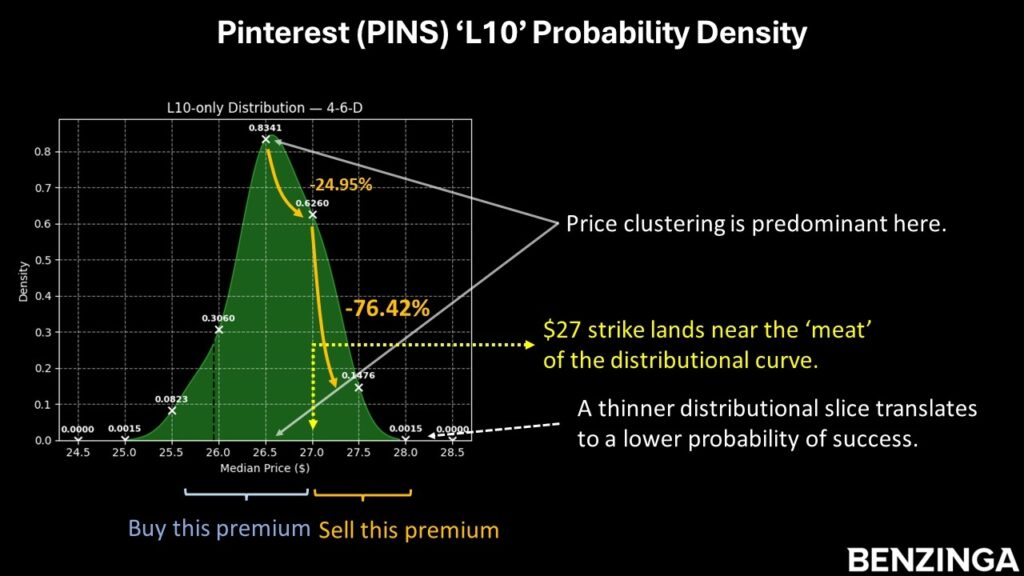
Stated differently, by using a vertical spread, we can buy the premium associated with the realistic portion of the probability curve (up to $27) while selling the premium associated with the unrealistic portion (anything beyond $27). Yes, this caps our reward potential but it would also discount the net long exposure to a future event that is most realistic.
Think about it this way. Why pay for exposure to, say, $40 if you know that statistically, such a rise over a short period of time is practically impossible? You’d rather only pay for the premium that is realistic and that’s what the 26/27 bull call spread expiring Feb. 20, 2026, accomplishes. Should Pinterest stock rise through the $27 strike, you’re looking at a maximum payout of 104%.
The more aggressive idea would be to consider the 26/28 bull spread, also expiring Feb. 20. Here, PINS stock must rise through the $28 strike to trigger the max payout of roughly 133%. What makes this proposition tempting is that the breakeven price sits at a realistically attainable $26.86.
Honestly, the choice of spread comes down to personal risk tolerance. In my view — and based on the volatility of PINS stock — the 26/27 spread may be the most balanced trade.
The opinions and views expressed in this content are those of the individual author and do not necessarily reflect the views of Benzinga. Benzinga is not responsible for the accuracy or reliability of any information provided herein. This content is for informational purposes only and should not be misconstrued as investment advice or a recommendation to buy or sell any security. Readers are asked not to rely on the opinions or information herein, and encouraged to do their own due diligence before making investing decisions.
Read Next:
Image: Shutterstock