Image credit: Author
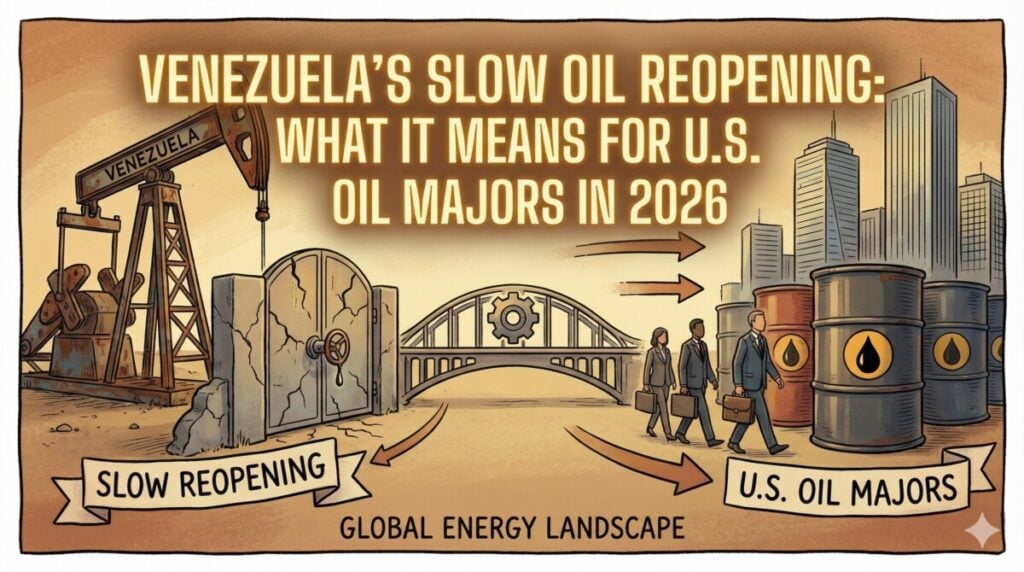
Venezuela’s oil sector is back in headlines, but not for the reason many investors assume. Oil is not suddenly flooding back into global markets, and supply has not meaningfully shifted yet. What has changed is regulatory posture.
The White House has allowed limited licenses and operational preparation to move forward, signaling a cautious thaw after years of sanctions. That distinction matters for investors, especially those watching large U.S. oil producers that operate on long timelines and geopolitical risk.
For U.S. oil majors, Venezuela’s slow reentry is not about near-term barrels. It is about optionality, political risk, and how supply narratives can influence valuations long before production changes show up in data.
Venezuela Is Reopening At The Margins, Not At Scale
Venezuela remains one of the world’s largest holders of proven oil reserves, but production capacity is a separate issue. Years of underinvestment, sanctions, and infrastructure decay mean output cannot rebound quickly even if policy allowed it.
In late 2023 and throughout 2024, the U.S. Treasury granted limited licenses that allowed companies like Chevron Corp. (NYSE:CVX) to resume restricted operations. These licenses primarily cover maintenance, debt repayment, and incremental exports, not a full commercial restart. OFAC guidance shows the intent is controlled engagement rather than full normalization.
Multiple energy analysts and government agencies have emphasized that Venezuela’s production increase so far has been marginal. Output has stabilized and edged higher in certain fields, but remains well below historical levels. According to the U.S. Energy Information Administration, production constraints remain structural rather than political.
This matters because headlines often imply a binary shift. In reality, Venezuela’s oil recovery is slow, conditional, and reversible.
Why The Distinction Matters For Investors
Oil markets price expectations long before barrels move. Even the perception of future supply can affect sentiment toward energy stocks, inflation forecasts, and geopolitical risk premiums.
However, Venezuela’s current status does not meaningfully alter near-term global supply. OPEC production discipline, Middle East risk, and U.S. shale dynamics still dominate the oil balance.
For investors in U.S. oil majors, Venezuela’s importance lies in long-term positioning. These companies think in decades, not quarters, and access to stranded reserves can become valuable if political conditions stabilize.
That optionality is valuable, but it is also fragile.
Chevron’s Position Highlights The Opportunity And The Risk
Chevron remains the most exposed U.S. oil major in Venezuela due to its legacy presence and existing joint ventures. Under current licenses, Chevron can operate limited activities and export some Venezuelan crude, primarily to the U.S., where it is refined and sold.
This arrangement improves Chevron’s cash flow efficiency and allows Venezuela to service debts, but it does not represent a full return to pre-sanctions operations. The company has repeatedly stated in filings and earnings calls that its activities are constrained by license terms and subject to renewal risk.
Reuters reported exports remain modest relative to global oil flows, reinforcing that this is a regulatory experiment rather than a structural shift.
For investors, Chevron’s Venezuela exposure adds geopolitical optionality without materially changing near-term earnings.
Trump As A Political Risk Factor, Not A Forecast
Former President Donald Trump’s role in this discussion is best understood as a source of uncertainty, not a prediction. During his administration, U.S. sanctions on Venezuela tightened significantly, cutting off most oil exports and isolating the country from global markets.
A potential Trump return to office raises the possibility that Biden-era licenses could be revoked or allowed to expire. Past sanctions policy illustrates how quickly access can change under a different administration.
Markets tend to discount these risks gradually, often through valuation multiples rather than earnings forecasts.
Why Exxon And Other U.S. Majors Still Matter Here
Exxon Mobil Corp. (NYSE:XOM) does not currently operate in Venezuela at scale, but it remains relevant to the discussion. Exxon’s global portfolio benefits from supply discipline and geopolitical friction that supports oil prices.
If Venezuelan supply remains constrained, price support persists. If supply expands meaningfully in the future, majors with diversified assets are better positioned to absorb price pressure.
Other majors like ConocoPhillips Co. (NYSE:COP) and Occidental Petroleum Corp. (NYSE:OXY) benefit indirectly from supply tightness and long-cycle investment discipline.
The Reality Of Venezuelan Production Capacity
It is important to separate reserves from deliverable supply. Venezuela’s oil infrastructure requires billions in investment to return to former output levels. Pipelines, refineries, and export terminals have deteriorated, and skilled labor shortages persist.
International Energy Agency assessments indicate that even under optimistic policy conditions, Venezuela would need years to restore production meaningfully.
This reality limits downside risk for U.S. oil majors in the near term.
What Investors Should Actually Watch
Rather than reacting to headlines, investors should track three indicators: First, monitor U.S. Treasury license renewals and language changes. Second, watch capital spending commitments from Chevron and others. Third, follow export data rather than political commentary. Actual shipment volumes tell the real story.
The Bottom Line For U.S. Oil Majors
Venezuela’s oil sector is reopening slowly and conditionally. Production has not surged, and full-scale flows have not resumed.
For U.S. oil majors, this creates optionality without near-term earnings dependence. Chevron has the most direct exposure, while Exxon and others benefit indirectly through market structure.
Venezuela does not change the near-term outlook for U.S. oil majors. It adds long-term uncertainty that markets continue to price cautiously.
Benzinga Disclaimer: This article is from an unpaid external contributor. It does not represent Benzinga’s reporting and has not been edited for content or accuracy.